| ⚡ Quick Verdict If you run an e-commerce store and revenue is your north star Klaviyo wins, and it’s not even close. Mailchimp is excellent for general small businesses just getting started, but the moment you need real segmentation, revenue attribution, or Shopify-grade automation, Mailchimp simply can’t keep up. |
Table of Contents
You’ve seen the comparison posts. They all follow the same script a feature table, a non-committal « it depends on your needs, » and zero real guidance. This is not that post.
I’ve used both platforms across dozens of e-commerce and DTC brands. I’ve built flows, broken segmentation, and watched campaigns generate or quietly kill revenue. In 2026, the gap between Klaviyo and Mailchimp has never been more pronounced. Here’s the straight answer.
Overview: Klaviyo vs Mailchimp
Before comparing features, you need to understand what each tool was built to do because that shapes every decision they make.
Klaviyo — Built for Revenue
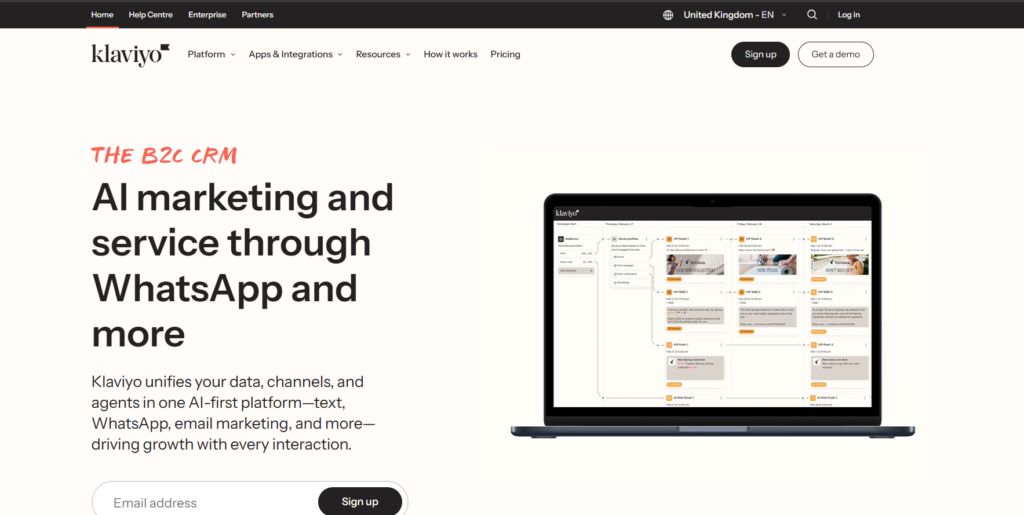
Klaviyo launched in 2012 with a single obsession: help e-commerce businesses make more money from email. Every feature, every data model, every UI choice reflects that goal. They don’t just send emails they track which email drove which purchase, how much that customer spent, and when they’re likely to buy again.
After going public in 2023, Klaviyo has doubled down on AI-powered predictive analytics churn risk scoring, next purchase date predictions, and customer lifetime value modeling. In 2026, these features are mature and genuinely useful.
Mailchimp — Built for Simplicity
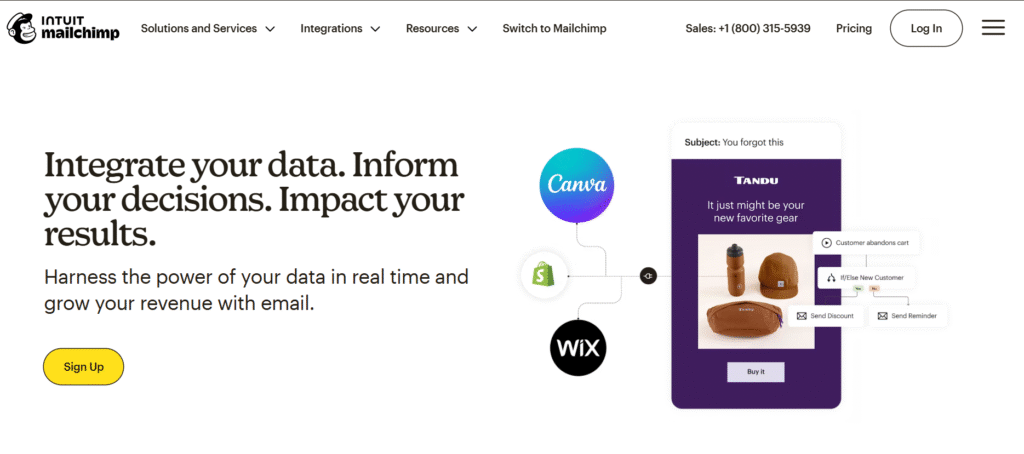
Mailchimp launched in 2001 as a newsletter tool for anyone. For years, it was the default starting point bloggers, restaurants, nonprofits, local businesses. After Intuit acquired them in 2021, the platform has pivoted toward becoming an all-in-one marketing hub for small businesses.
They’ve gotten better: automations are more capable, templates are cleaner, and the free plan is genuinely generous. But the core DNA remains broad, accessible, general-purpose.
| 📌 The Fundamental Difference Klaviyo is a revenue intelligence platform that happens to deliver emails. Mailchimp is an email marketing tool trying to become more. That distinction explains every difference on this list. |
Feature Comparison
| Feature | Klaviyo | Mailchimp |
|---|---|---|
| Email Campaigns | ✓ Advanced | ✓ Advanced |
| SMS Marketing | ✓ Native, robust | ~ Limited |
| Drag & Drop Editor | ✓ Yes | ✓ Yes (more templates) |
| E-commerce Integrations | ✓ Deep (Shopify, WooCommerce…) | ~ Basic |
| Revenue Attribution | ✓ Per-email, per-flow | ✗ Minimal |
| Predictive Analytics (AI) | ✓ CLV, Churn, Next Purchase | ✗ Basic only |
| Advanced Segmentation | ✓ Behavioral, predictive, purchase data | ~ Tag-based only |
| A/B Testing | ✓ Flows + Campaigns | ~ Campaigns only |
| Dynamic Content | ✓ Full liquid templating | ~ Limited |
| Free Plan | ~ Up to 250 contacts | ✓ Up to 500 contacts / 1,000 emails/mo |
| Landing Pages | ~ Basic | ✓ Good built-in builder |
| Social Ads Integration | ~ Limited | ✓ Facebook & Instagram Ads |
E-commerce Integration & Data Depth
When comparing Klaviyo vs. Mailchimp on e-commerce integration, the difference is immediately clear.
Klaviyo
Klaviyo is built specifically for e-commerce and comes with deep integrations with platforms like Shopify, WooCommerce, BigCommerce, and Magento and many of its core features, like segmentation, product feeds, and revenue tracking, depend on this connection.
Klaviyo’s sync with Shopify captures behavioral signals that no other platform matches at scale browsing behavior, predictive LTV, churn risk scores, and purchase frequency patterns are all native to the platform, not add-ons.
Mailchimp
Mailchimp tells a different story. Mailchimp’s native Shopify integration was discontinued, and users now have to rely on third-party solutions like ShopSync. This added step weakens the connection and can limit access to critical e-commerce features such as real-time product syncing or personalized product blocks.
Revenue Reporting
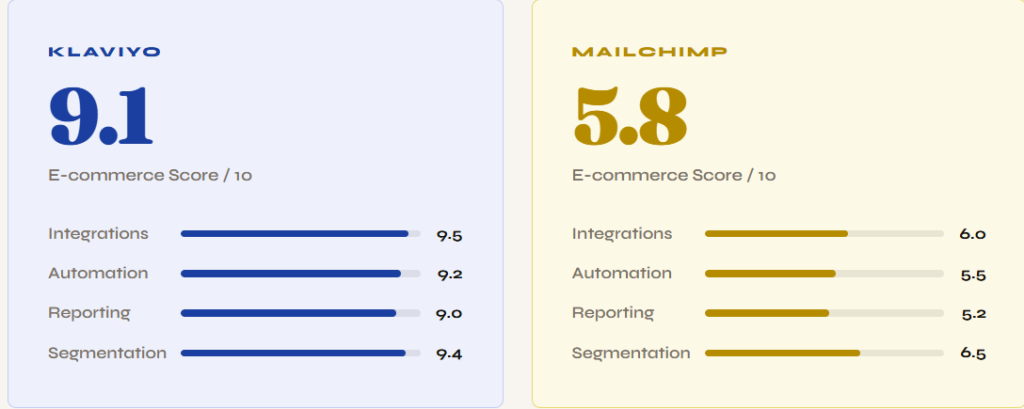
Klaviyo shows you revenue attributed to every single email, flow, and segment. You know exactly which subject line and which product block drove the sale. Mailchimp’s revenue reporting exists but is shallow aggregate conversion data, not the per-email intelligence that lets you optimize relentlessly.
Automation & Workflow Customization
Automation is where the Klaviyo vs. Mailchimp gap becomes most visible and most impactful for your bottom line.
Klaviyo: Flows Built Around Behavior
Every paid Klaviyo plan includes access to sophisticated automation flows triggered by real-time behavioral data. You can build welcome series that adapt based on how recipients engage, abandoned cart sequences that trigger within minutes of cart abandonment, browse abandonment flows for high-intent visitors who don’t purchase, post-purchase sequences that vary by product purchased, win-back campaigns based on predicted churn, and replenishment reminders calculated from average reorder cycles.
Klaviyo automations called « flows » are built around event triggers and split logic, with performance metrics shown directly inside the builder. Flows can include email, SMS, and push steps all within a single workflow. That means you’re not just automating emails you’re orchestrating the full customer experience across channels, all from one place.
Mailchimp: Journeys Built Around Simplicity
Mailchimp includes pre-built automation for welcome emails, abandoned cart recovery, order notifications, product retargeting, birthday messages, and re-engagement campaigns. You can create custom automation with multiple steps and basic conditional logic based on campaign activity or audience data.
Mailchimp comes with 70+ ready-made marketing automation templates that you can customize to your needs. which makes getting started fast and painless. For a small business sending a welcome sequence or a post-purchase follow-up, that’s more than enough.
The limitation kicks in when you need more. Mailchimp’s automation capabilities are solid for businesses with straightforward needs, but lack the behavioral sophistication of Klaviyo. You can’t trigger based on real-time browsing behavior, predicted lifetime value, or complex combinations of purchase patterns. The automation builder also lacks visual workflow mapping, making complex sequences harder to conceptualize and troubleshoot.
Segmentation Capabilities
Segmentation is the heart of effective email marketing and in the Klaviyo vs. Mailchimp comparison, this is where the two platforms diverge most dramatically.
Klaviyo: Unlimited, Real-Time
Klaviyo tracks hundreds of data points automatically once connected to your store every product viewed, items added to cart, purchase history, average order value, total revenue per customer, days since last purchase, predicted next order date, and predicted lifetime value.
Klaviyo doesn’t limit the number of conditions you can use per segment, meaning you can get really granular and send hyper-specific emails to very small, high-intent groups. More importantly, Klaviyo segments update in real time based on incoming data, so your audience is always accurate, without any manual refreshing before each send.
Klaviyo takes segmentation further by combining multiple event-based conditions, including positive and negative purchase behavior at the product-variant level. For example: customers who bought Product A but never Product B, with a predicted LTV above $400, who haven’t opened an email in 45 days. That’s a precise, revenue-ready segment built in minutes.
Mailchimp: Simpler, But Limited
Mailchimp allows segmentation based on standard criteria like signup date, location, campaign engagement, tags, and basic purchase data. The interface is user-friendly, but it doesn’t offer the same depth of behavioral data that Klaviyo provides automatically.
The two biggest limitations? First, Mailchimp limits segments to 5 conditions per segment a real ceiling when you need precise targeting. Second, Mailchimp’s segments are static by default and don’t automatically update unless you manually refresh them or set up specific automation rules.
There’s also a cost problem: Mailchimp charges you separately for each audience. If the same contact appears in multiple audiences, you’re paying for them multiple times. Klaviyo charges per contact not per list so you can place one contact in multiple segments without inflating your bill.
Email Design & Ease of Use
In the Klaviyo vs. Mailchimp comparison, this is the one category where Mailchimp clearly takes the lead and it’s worth being upfront about that.
Klaviyo: Powerful, But Built for E-commerce First
Klaviyo offers around 100 templates specifically designed for e-commerce scenarios abandoned cart recovery, browse abandonment, post-purchase follow-ups, win-back campaigns, product launches, and seasonal promotions. Every template is optimized for showcasing products, with strategic placement of images, pricing, reviews, and call-to-action buttons.
The real power of Klaviyo’s editor isn’t the templates it’s what you can do inside them. Klaviyo’s standout feature is the Product Block, which automatically pulls product images, names, and prices from your store. You can filter products by category or show items based on what each customer viewed or added to their cart, making every email feel personal.
he builder also includes conditional logic that lets you show different content blocks to different segments within the same campaign meaning one email can display entirely different products to different customers based on their browsing history or past purchases. Mailchimp That level of personalization simply doesn’t exist in Mailchimp.
The trade-off? The Klaviyo email editor has a steeper learning curve for beginners. Its advanced customization and automation features can be overwhelming for new users.
Mailchimp: The Friendliest Editor in the Game
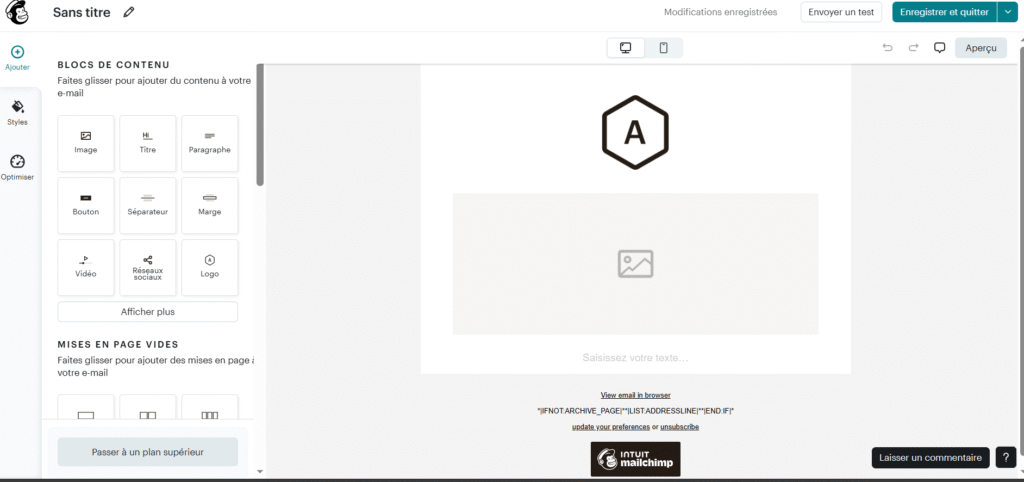
Mailchimp’s user-friendly interface is a longtime favorite featuring a drag-and-drop editor that requires no design or coding background and professionally made templates to get started with quickly.
The template library is genuinely impressive. Mailchimp offers 135+ professionally designed newsletter templates, categorized by use case sales and promotions, order confirmations, onboarding, holiday messages, and company updates. For a small team without a dedicated designer, that breadth is a real advantage.
Two standout features make Mailchimp’s design experience even smoother. First, the Creative Assistant brand kit feature lets you upload your logo and Mailchimp automatically pulls your fonts, colors, brand personality, and button styles from your site. Second, all Mailchimp plans include access to Content Studio a digital asset management platform that stores your images, files, and brand assets in one place for easy reuse across campaigns.
Pricing Breakdown
Both platforms price based on the number of contacts. Here’s how they compare at common list sizes:
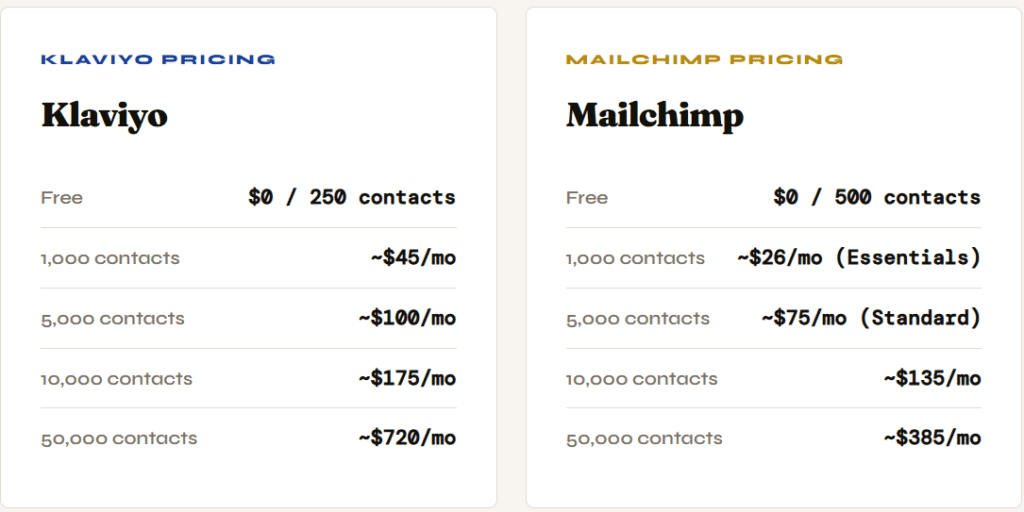
| ⚠️ The Pricing Trap Mailchimp is cheaper at every list size, but that comparison is misleading. Klaviyo’s revenue attribution consistently shows 15–30% higher email-driven revenue for e-commerce brands. A platform that costs more but generates significantly more revenue isn’t expensive it’s an investment. Don’t optimize for tool cost. Optimize for revenue per email sent. |
SMS & Multichannel Marketing
In the Klaviyo vs. Mailchimp debate, SMS and multichannel capabilities are becoming increasingly important and the two platforms approach this very differently.
Klaviyo: SMS and Email as One Unified System
Klaviyo wasn’t late to SMS it built it directly into its core. With Klaviyo, you can send abandoned cart texts, shipping notifications, delivery confirmations, review requests, and promotional campaigns all coordinated with your email strategy. The platform handles compliance automatically with proper opt-in collection, unsubscribe management, and regulatory requirements for different regions.
The real advantage is the unification. SMS and email share the same segmentation and personalization capabilities in Klaviyo, creating a truly unified multichannel experience. That means a customer who clicks an SMS link but doesn’t purchase can automatically receive a follow-up email all within the same flow, no extra setup required.
Beyond SMS, Klaviyo AI helps brands build cohesive omnichannel journeys across email, SMS, WhatsApp, and web chat to deliver the right message at the right time on the right channel with features like channel affinity, which learns each customer’s preferred channel and adjusts automatically.
Mailchimp: SMS is There, But It’s an Add-On
Mailchimp added SMS more recently, and it shows. You can send standalone SMS campaigns and basic automated messages, but the coordination between email and SMS feels less seamless. Compliance tools are adequate but not as robust as Klaviyo’s purpose-built system.
On the broader multichannel side, Mailchimp supports email, SMS, and a broader range of integrations including social media platforms like Facebook, Instagram, and Google making it more versatile for businesses that rely heavily on paid social alongside email. However, Mailchimp’s multichannel flows support email and SMS but lack the sophisticated AI decisioning needed for complex customer journeys.
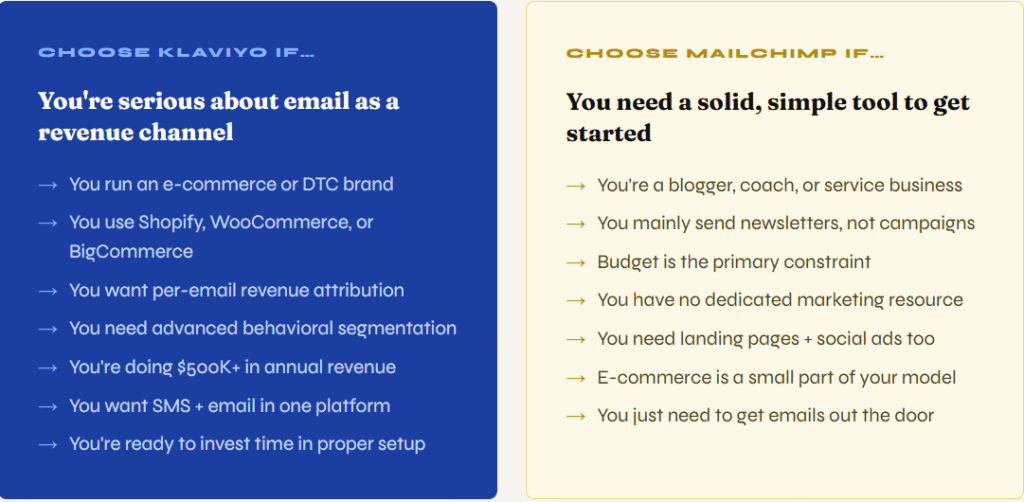
Who Should Use Each Platform?
Conclusion
For E-commerce? Klaviyo.
For Everything Else? It Depends.
If you sell products online and you’re serious about growing revenue through email, there is no better platform than Klaviyo in 2026. The data depth, the revenue attribution, the automation power nothing else at this price point comes close.
If you’re a service business, content creator, or early-stage brand that just needs to maintain contact with an audience, Mailchimp will serve you well and its free plan is one of the best in the industry for getting started.
The mistake I see most often: e-commerce brands staying on Mailchimp because it’s familiar, while leaving real money on the table every single month.
| Category | Winner | Notes |
| E-commerce Revenue | Klaviyo | Revenue attribution alone justifies the switch |
| Automation Power | Klaviyo | Flows are deeper, smarter, and more profitable |
| Segmentation | Klaviyo | Behavioral + predictive segmentation is Klaviyo’s superpower |
| Ease of Use | Mailchimp | Better templates, smoother onboarding, gentler learning curve |
| Pricing (raw cost) | Mailchimp | 20–40% cheaper at equivalent list sizes |
| Price-to-Revenue Ratio | Klaviyo | More expensive, but generates disproportionately more revenue |
| SMS Marketing | Klaviyo | Native SMS is mature and tightly integrated with flows |
| General Business Use | Mailchimp | Better fit for non-e-commerce use cases |
| Free Plan | Mailchimp | 500 contacts and 1,000 emails/mo vs. Klaviyo’s 250 |
| AI & Predictive Features | Klaviyo | CLV predictions, churn risk, next purchase date are genuinely useful |
| Discover more guides to grow your business. Did you enjoy this article? Explore our other practical guides to boost your online business and find the tools that suit you best. |